RCO Hierarchy: What Is It?
What Are Components?
What Are Content Objects?
What Are Topics?
Topic Groups
R C O H I E R A R C H Y
RCO Hierarchy: What Is It?
The RCO Strategy is a three-level architecture, consisting of components, reusable content objects, and topics. These three levels form a hierarchical relationship.

This division of content and the attributes attached to each level allow for maximum reuse, particularly across training and performance support contexts.
Components are the raw media atoms that make up content objects.
What Are Components?

Component types include text types such as paragraph, bullet list, numbered list, and table, and other media types such as photograph, graphic, audio narration, other audio types, video types, animation types, executable macros, and so on.
Components stored in a database, such as photographs or audio clips, are identified and searchable by name, subject area, and component type. There may be some additional attributes specific to some types of media. For example, video may have time related attributes, where text would not. Some component types, such as text components, may be not stored separately in a database but incorporated directly into a content object.
In the assembly of learning or support topics, a content object is the smallest usable, meaningful unit of content.
What Are Content Objects?
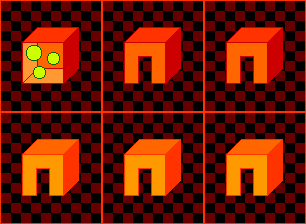
A content object is the smallest unit identified to creators. It is a smaller granule of content than a topic. Not only is it smaller in the amount of content but it is also smaller in the purpose of the content.
A topic has a single instructional or performance goal, such as:
- Teach a skill
The topic will have one or more content objects, each of which provides a single type of interaction to help achieve that goal, such as:
- Introduce the skill
- Demonstrate the skill
- Allow the end user to practice the skill
- Test the skill
Content objects are the individual pieces that are combined to produce the learning or performance outcome of the topic.
A topic is a small but complete instructional or performance support interaction —probably more than a page, but certainly less than a full course.
What Are Topics?
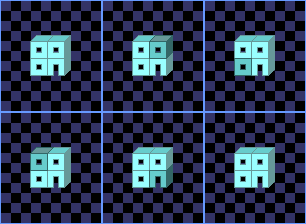
Topics are the smallest unit identified to users (such as learners). A topic has a single instructional objective or performance support goal.
A topic can contain one or more content objects.
Examples of topics:
- Web-based training tutorials
- Searchable reference job aids
- Online help pages
- System messages
Topics will, of course, be combined into topic groups such as courses, curricula, help systems, and custom learning paths.
Topic Groups

The linking of topics into topic groups can be done by the creator at the time of creation or later by others who need to assemble collections of content for specific needs.
Topic groups can be labeled with the same attributes as a topics. However, to reflect the more complex nature of a topic group, these attributes will be allowed to have multiple values. These values could be the collection of all the values "inherited" from the topics contained in the topic group, but it will often be more useful to select a set of values that better reflects the purpose of the topic group as a whole.
home | glossary | credits | tell us what you think | © 1997 Oracle Corp.